The project

Our knowledge of ecology of migrants in their wintering grounds is extremely poor and severely hampers our ability to explain these declines and conserve this group of species. We lack even basic information about when birds arrive, the habitats they use and how they move around Africa.

The aim is to understand how Palearctic-African migrants use and move around the different vegetation zones found in West Africa, ranging from the semi-desert Sahelian region in Burkina Faso to the lush tropical rainforest in southern Ghana, and whether habitat change may impact them on their wintering grounds.

During the temperate winter of 2009/2010, using point count methodology and mist-netting, we recorded migrants along a degradation gradient at five different stations on a north-south transect. In 2010/2011 we plan to re-visit these sites as well as roving further afield to get a broader picture of migrant habitat use.
Showing posts with label Warblers. Show all posts

13th – 24th Feb: The (almost) 12 days of transects


A pretty gruelling trip of roving this time around!  Started off very well with a stop-over at the BTO team’s place (no time to visit the study site itself or help with fieldwork sadly, but great to see everyone) in Nsoatre.  An absolutely mind-blowing creation of various dishes was unveiled by Eric for our dinner.  Never eaten so well in Ghana – thanks Eric!

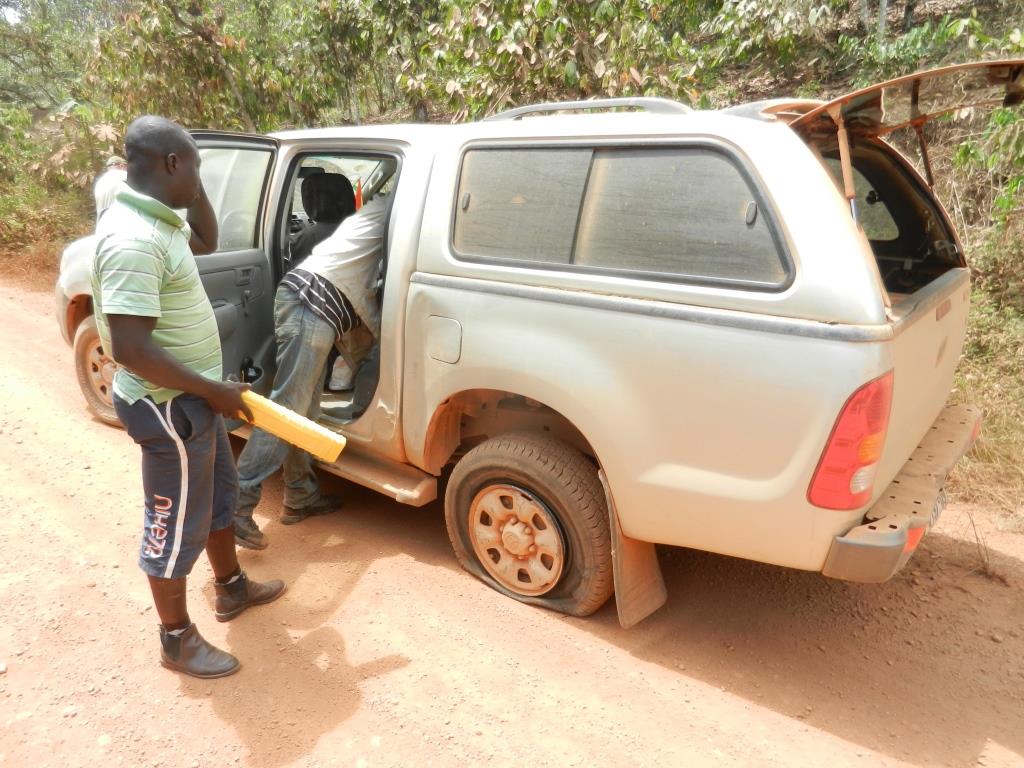
The next 11 mornings took in a loop from Asukese/Bia Tano and  Ayum forest reserves in SW Brong Ahafo Region, through Western Region’s Krokosua, Dadiaso, Boin River, Fure River and (slight hiccup in the loop here, with a puncture and a missing bridge meaning we couldn’t reach our intended destination of Samremboi, and had to divert some distance and do Fure River first, and then went on to…) Tano Nimiri.
Oppong & Japheth sort out a slight problem with the tyre....

....and find a solution to the missing bridge!


The usual pattern continued with, generally speaking, more wood warblers outside the forests than inside, although the farmland sampled at Krokosua was “thungya” plantain plantation inside the forest, where several wood warblers were located.  This “thungya” system is where plots within a forest can be farmed, provided all of the trees above a certain height are left in place.  In completely ruins the habitat for true forest specialists, as there is no natural understorey, and no mid-level canopy.  However, if sufficient trees of the right species mix are left to thrive then it would seem that wood warblers can be supported in reasonable numbers, just like any reasonably well-wooded farmland outside the forest.
There was mixed success when locating 1km transects at 5, 7 & 10km from the nearest forest, although we were surprisingly lucky in many instances to find good roads leading to good farm tracks that were within exactly the right distance band.  The presence/absence of wood warblers did not always follow the expected pattern however!  Some of the closer-to-forest transects held none, whilst one transect that we reached, at a full 15km from the nearest forest at the Dadieso site, did have a bird.  At this site we also had a bird at 7km, but none at 10km or 5km.  We hope that overall some patterns will emerge!  All of the ground covered is going to greatly improve the model for predicting wood warbler presence and absence in Ghana, ground-truthing for which was a large part of last season’s work.

As if the puncture and search for new tyre weren’t enough, though, a major car crisis emerged on day 7, when all sorts of horrid noises were coming from the clutch.  After a visit to a local garage and a few phone calls to the experts made by Japheth, and the prognosis was not going to be good if we continued to drive the car.  Thus it was decided that Oppong and I would take it gently to the garage at Tarkwa, whilst Roger and Japheth continued with the fieldwork without the car – but with taxis instead!

2 days in Tarkwa for two of us, then, during which a pricey car-job is undertaken. Once sorted, we head north again to meet the other two.  In the meantime, Rog and Japheth have managed to do a taxi-recce from Asenkagrua into the forest at Totua Shelterebelt, taxi to survey their chosen spot the next day, taxi on to Diaso, find accommodation, recce the farmed forest at Upper Wassaw, survey that the next morning, and taxi to and get accommodation at Bibiani.  Such a dedicated team we have that, despite the car being off the road, there’s been no break in the programme of fieldwork (and taxis much cheaper than car-hire too!) Absolutely sterling work chaps!

The final 2 mornings take in Asenanyo and Tano Offin forests in Ashanti Region.  Wood warblers are still present in all areas, but at the latter, a particularly degraded patch of forest, we get more of them inside the forest than outside.  The numbers are pretty small here though, so difficult to draw any conclusions, and the final 10km distance transect, getting pretty close now to Ghana's second city of Kumasi, finds no wood warblers at all.
A solitary Ceiba tree, occupied by a lone wood warbler

With lots of ground covered and little time to spare over the past 11 days, in 11 towns and 11 different guest houses and twice as many chop-bars, we’re looking forward to getting back to base at the study site get some data entered, count “our” birds, and get stuck into the radio-tracking once again. (oh, and wash some clothes!!!)
Prestea, and one of the nicer guest houses visited

Roger on one of the many rickety bridges crossed


Japheth, Roger & Oppong, in perhaps the smallest restaurant in Ghana!

Heading back to Pepease, we are only too aware of the change that is afoot over the next few days. Oppong, our driver, cook and companion over the last 2 seasons, is leaving us for pastures new. Soon after our arrival back at base, his good friend and replacement Derek arrives, to learn the ropes from Oppong before he departs on the 27th. Fingers crossed Derek can cook at least as well as Oppong!!

15th-27th Jan: Into the forest zone....


After an unavoidable 2 nights in Accra to obtain our permit to work in the forest reserves, we head west along the Cape Coast road. The first bout of roving takes in Kakum national park and adjacent forest and farmland, and 4 other forest blocks in a transect south to north. We have moderate success finding wood warblers in degraded forest edges, but in the closed canopy within Kakum for example, we find none.  Without the playback this would come as no great surprise perhaps, but the output from the playback device is pretty powerful, and we’re fairly sure that we should have had some response if the birds were up there. Do they really not like the forest interior?

Further north near to Lake Bosumtwe we barely touch proper forest, our path taking us through farms within the forest reserve, and timber plantations that are perfectly normal practice in these reserves of resource, rather than those of biodiversity such as the national parks.  Here we detect double figures of wood warblers, with a minimum of 6 calling from within the rather regimented plantation. Again, more questions are raised as to the preferred habitat of wood warblers in Ghana!


Roger & Japheth listen out for wood warblers in plantation within Bowumtwi forest reserve

We return to the study site in Kwahu for a site survey, producing similar numbers of birds to our previous count 2 weeks ago, and also reminding us of just how good the wooded farmland is here with higher densities than all of the 6 sites we traversed in the previous week. With an up-coming visit from Dr Danaë Sheehan and several other luminaries from the UK, Denmark and Poland, we can expect plenty of discussion as to how to progress and answer many of the questions that we are left pondering.

Sunday 6th –Mon 14th Jan 2013 Back to Ghana, and a visit from the experts!

The New Year is underway, and the Ghana wood warbler team is augmented by the arrival from the UK of project manager Danaë Sheehan and head of species recovery Norbert Schaffer from the RSPB’s International department, and Franz Bairlein, from the Institute of Avian Research in Germany and one of the world’s foremost bird migration experts, all here to visit the study site and formulate a programme of fieldwork for the remainder of this season and for those to come.

After a brief visit to Ghana Wildlife Society HQ, we set off for the study site, the old team feeling a little anxious as to what first impressions the ‘new’ members will get from the wooded farmland at Pepease.  For our first morning in the field we walk the usual transect route that we follow to do the regular wood warbler survey.  Our own first impressions are that the vegetation has not dried out anything near as much as it had done by January of last year.  The air is dry, suggesting the harmattan may be just starting, but very little burning has taken place.  Thankfully we’re able to find a few wood warblers for the visitors, but here in the eastern section of the site, where no wood warblers were ringed last month, no colour ringed birds are spotted.  The following morning we head for the western side, where last month we caught and colour-ringed 11 birds.  This time we spot 4 of these, and a decent number of unringed individuals too.  Of note was the number of birds that could be seen with incomplete tails, demonstrating nicely that they are well into their winter moult.  All in all a great introduction to the site, and aside from the field visits some very interesting discussions about the future directions for the fieldwork were had.

Danaë, Norbert and Franz continued their Ghana visit with a trip to the lowland forest zone, whilst over the next 3 days we undertook a full site survey, with additional waypoints through a site extension encompassing the area inhabited by Black Star, our second tagged bird from last November. We then tackled the issue of some habitat recording for the areas occupied by the three tagged birds from November and December, and also spent time dissecting some of the whole-site habitat survey from the end of last season, before we embark on mapping any changes in late March.  Throughout this period we note that after the dry air of the 7th and 8th of January, the humidity levels have risen again.  There really is no sign of the harmattan yet....

Our study-site tasks completed, we then planned our own foray into the forest zone.  With the local wood warblers in moult rendering them near un-taggable, and after our experience last season of failing to catch any in January and early February (save the one tail-less individual!), our next job is to visit as many of the forest blocks in the south as possible. The aim is as last season – to prove or otherwise the presence of wood warblers in the forests that we have not yet visited, to improve the model that will help to predict the presence or absence of wood warblers elsewhere.  On top of this, we will attempt to measure wood warbler densities in the varying forest types and qualities, and where time permits, the adjacent farmland.  Should prove pretty interesting!!

18 Jan: Melodious and gropper

After a rather noisy night- (every night is party night in a Ghana), we got up at 5 to a healthy pineapple and bread breakfast. The first net round saw a rush of Palearctic migrants with 5 Garden Warblers, 2 Reeds Warblers, 1 Grasshopper Warbler and 1 Melodious Warbler. From the guide book recently published on Ghanaian birds ‘groppers’ shouldn’t be here so it’s an interesting species to catch, Bee says there has been one seen before Christmas too- so not just a fluke! I’d not seen a melodious before so it was great to have the chance to ring it (thanks Ian). They look superficially like an Icterine, but smaller and quite yellowy green whereas Ickies tend to have a buffy tinge and a thinner looking bill. Also I find Icterines tend to shout at you in the net, and this little bird stayed very quiet.
We colour ringed all the migrants and took, feather, faecal and blood samples for analysis in the lab later, as well as fat and muscle scores. None seem to carry a lot of fat, the Garden Warblers were carrying some - up to score 3. Afrotrops caught were a Greenbul, Bronze Mannikin, and Red-headed Quelea. We also saw some European Bee Eaters fly over. After all the birds were ringed we packed up shop and had a civilised lunch at the dining table. Bee and I did our impression of two washer women as Ian sorted out charging flat batteries and action man Oppong helped me put up an ad hoc washing line. Nets will go up later today and hopefully it will be a good day.#

Above: Grasshopper Warbler


Above: Melodious Warbler

Posted on behalf of Vicky