The project

Our knowledge of ecology of migrants in their wintering grounds is extremely poor and severely hampers our ability to explain these declines and conserve this group of species. We lack even basic information about when birds arrive, the habitats they use and how they move around Africa.

The aim is to understand how Palearctic-African migrants use and move around the different vegetation zones found in West Africa, ranging from the semi-desert Sahelian region in Burkina Faso to the lush tropical rainforest in southern Ghana, and whether habitat change may impact them on their wintering grounds.

During the temperate winter of 2009/2010, using point count methodology and mist-netting, we recorded migrants along a degradation gradient at five different stations on a north-south transect. In 2010/2011 we plan to re-visit these sites as well as roving further afield to get a broader picture of migrant habitat use.

Thursday-Sunday 01-04/12/11 Now failing to catch....

Above photo: fog blankets the study site

Over the next few days we attempt to catch each morning, and after an hour of trying on each occasion we remain on 3 tagged wood warblers – not one more bird caught. We follow this with the tracking of the first 3 birds, and on the Sunday we also undertake a full survey along the usual transect route.
Above photo: misty morning

Above photo: centre of study site with the mist lifting

Above photo: pied hornbill calling

Above photo: late morning, Japheth tracking bird 1 in the valley bottom

Above photo: in denser vegetation making things more difficult

What was interesting from the survey was the lack of wood warblers seen aside from those that we already knew about and had tagged! In fact, bird 3 was spotted 300m from it’s usual spot without resorting to tracking. We did encounter a total of 5 others, in just 2spots. With 4 of these in one place, the Monday morning netting attempt was going to be right next to this spot.


Meanwhile on Sunday we're invited to take lunch with Ola our landlord - a fabulous mix of all sorts of traditional Ghanaian dishes, served up al fresco in the shade of the large gazebo in the grounds. We really shouldn't get used to this!!

Above photo: taking some lunch with the landlord

Above photo: yam, kenkey, rice balls, tilapia and bush-meat, followed by strawberries and icecream!

Bee, Chas and Oppong have begun to wind things up over at the nightingale site, completing the habitat mapping. Amazingly, Chas got to spot a grasshopper warbler during fieldwork, according to the field guide a species not normally found this far south, in fact very rarely encountered in Ghana at all.

The final full site survey was carried out after some particularly damp weather conditions, which totally drenched the vegetation, and made the fieldwork a rather wet job!!


Above photo: no not rain, but the vegetation was soaking wet!

Still more incredible creatures have been to visit the Nsoatre team...


Above photo: an amazing butterfly

Above chameleon - now you see me...

...now you don't

Wednesday 30/11/11 Accommodation upgrade!

Above photo: dawn over the study site


We have another go at catching this morning, this time with two nets and mp3 players, set over 100m apart. We get a response near one net pretty quickly, but sadly the bird does not choose to descend into the net. Whilst waiting for a catch we take a short walk away from the net site and I spot 4 wood warblers foraging high up in a leguminous tree, so we decide to try here with the net tomorrow.

Above photo: Chris and Japheth tracking wood warbler 3


Perhaps it’s a good job we didn’t catch any more, as bird 3 gives us a bit of a run-around. It appears to have settled in a seemingly impenetrable patch of forest, so we spend a good while circling this patch and getting as many fixes as we can to pinpoint its whereabouts. We do catch up with bird 2, and thankfully we manage to see bird 1 in the valley once more, and in the same tree as yesterday.


Above photo: unidentified arachnid


After a good morning, we decide that it’s time to move into our new, and it has to be said a lot nicer, accommodation. Not a bad pad – and a nice view to boot!!

Above photo: our living room
Above photo: the view from the house


Bee and Chas have continued success at the nightingale study site, with all ten tagged birds still detectable, and catching efforts have even resulted in retrapping one of them, along with some more amazing African species.
Above photo: female green-headed sunbird


Above photo: the retrapping of a tagged nightingale

Above photo: Levaillant's cuckoo

Tuesday 29/11/11 Third wood warbler caught

Above photo: sunrise, and Emmanuel and Japheth are ready at the car for our next wood warbler

With Japheth back and our confidence with tracking increasing, we put a net up in a spot where yesterday we saw an unringed wood warbler. And bingo! After a half-hour of playback a bird is caught, and a few minutes later our third radio-tagged wood warbler is released. Brilliant!

On top of this capture success, we manage to see both other birds this morning – bird 1 for the first time!! This was foraging with an un-ringed bird in a bug-filled flowering tree by the river. Not identified it yet, but I think it might be a Berlinia species.

We manage to track and get fixes on bird 3 this evening. Hopeful to actually see it tomorrow!


Above photo: the GWS field vehicle, about to take us home...

Monday 28/11/2011 Checking out yet more new accommodation

It’s definitely beginning to look like the best system for a day’s tracking is to invest as much time as can be allowed to actually find each bird and get a waypoint for its location, and record some detail of behaviour, habitat, and tree species, and any association with other birds. Having said that, still not actually seen bird 1 yet – but we’re getting close!

Aside from tracking today, we have a meeting with the owner of some wholly decent accommodation on the edge of town. Essentially a holiday home/ weekend retreat for himself, he has built some chalets nearby and rents these out to local professionals. He says that sadly there is no free chalet at present, but explains that for our last two weeks we can move into 3 rooms in his own house! Deal done!!


The grounds of our prospective new accomodation


On our way back from fieldwork this evening we were treated to some pretty good views of long-tailed nightjars resting on the track ahead of us. This meant that poor Japheth had to wait a short while in town for us to pick him up. Sorry Japheth!


Above photo: long-tailed nightjar

The nightingale tracking continues anabated. The team now have a full complement of 10 radio-tagged birds, which has become quite a handful to track twice and even three times a day! Bee and Chas have also undertaken some more habitat mapping of the site, and during the course of fieldwork came across this rather confiding African crake:


Above photo: African crake

Sunday 27/11/2011 Moving from the mountain

Above photo: dawn over the valley


A second morning seeking out the birds, and we head straight for down into the valley where bird 1 was yesterday. We get a good signal from the word go. We find that the valley is in fact quite grassy and scrubby, demonstrating that we are at the very northern edge of the forest zone, and the southern edge of the savannah. Plenty of farmland at the bottom too, readily irrigated from the river continuing north towards the Volta, from the waterfall we passed yesterday. Wondering whether the bird will be accessible in the dense forest at the head of the valley, we’re pleasantly surprised to find that it appears to be hanging out at the farmland/forest edge. No matter how hard we try, however, we cannot see the bird, but feel we must be within 50m of it. A few decent fixes, and we’re pretty pleased with this so head for bird 2. Little problem finding this one, and we see it in a mixed canopy some 70m away from yesterday’s spot.


Above photo: early morning tracking


Considering our success so far, we decide to up-sticks from the mountain-top and head for the closer accommodation, so we head straight back to camp and start packing. We say our farewells to the caretakers, grab some lunch in Mpraeso, and head for the new guest house.


The afternoon foray into the field is spent in the valley, chasing after bird 1. It appears to have moved within some particularly troublesome shrubby terrain, and we take 2 hours to get 2 fixes, and as a consequence we end up with no time to search for bird 2. We decide that our pm fieldwork in future should start with bird 2, and then get as good fixes as possible on bird 1 from vantage points on the ridge above the valley.

Saturday 26/11/2011 First time wood warbler tracking

0600 sharp and Emmanuel and I are back at the ringing site. Headphones at the ready, we tune our tracking receiver into bird 1.

Nothing.

Not a peep from the receiver. A walk up the road and 100m in every direction, and still nothing. Wondering if the bird has moved on already, we decide to switch to bird 2, hoping for some reassurance that at least the equipment is working! Straight away we get a beep in the headphones. Very quickly we home in on the direction of the strongest signal, and make our way towards the bird.

Amazingly after about 45 minutes we not only pin-point the location of bird 2 about 160m from the ringing site, but we actually spot it, replete with colour rings, foraging a few metres above us in a path-side tree. What an amazing feeling! Yesterday we attached the tag wondering if we’d even get a signal from the birds today, and here were are actually watching one of them!! Brilliant.

Next task was to try again for bird 1. Understanding that the range of the tag is about 500m, up to 1km in the best conditions, we resolved to walk 500m in every direction from the ringing site. Should this fail, we’d expand the search to 1km, and then further if necessary. For the first foray off the main East-West track we head south, listening all the while for any signal from bird 1. An occasional switch to bird 2 shows that we can still detect it from up to 650m away, but 500m S of the ringing site, still no bird 1.

A short walk west along the main track we arrive at the village, and ask for a path northwards. We are pointed in the direction of the river, but are told we need a guide. A quick explanation that the Queen Mother has given us permission, and we’re waved on. About 150m after leaving the village, and bingo, I start to get the faintest signal from bird 1. Continuing on past the river, where it disappears underground and emerges at a sacred waterfall, we’re crossing a grassy, rocky plateau – quite unsuitable for wood warblers it would seem. The valley below is wooded however, and this appears to be where the signal is coming from. We find a path down towards the valley, through some farmland, and then further down to scrub on the edge of the forest. At this point the path runs out, so we take a waypoint and a compass bearing towards the strongest signal. We back-track and seek out other vantage points to take bearings, but back on the plateau we find that we’re heading further away from the signal as it gets weaker, and there seems no other way down to the valley. We decide to head back to the village, and from the road we can “circle” round to the other side of the valley, and maybe get bearings from the opposite ridge.


Above photo: underground river emerging into forested valley


The road runs south-north along the west side of the valley, and the slopes down are farmed and passable via many paths. We find one which takes us to a vantage point overlooking the valley, but still some 500m from where we were on the other side. A good signal from here, and we finally get a good picture from 2 more bearings. Happy with these “fixes”, and with the sun now high in the sky, we head back to our camp on the mountain.

En route through Abetifi we discover a fantastic little canteen in the grounds of the University, amazing value and service, probably cheaper in fact than catering for ourselves! We resolve to take our lunches here, and self-cater for breakfast and our evenings from now on.

After a long morning, we decide that we must move to Pepease tomorrow. This commute is just too long! It will be much more practical for tracking the birds twice daily.


Whilst out tracking the nightingales, Bee and Chas continue to engage with the locals, and the wildlife pin-badges are going down well.


Above photo: Bee with some local kids on their way to help on the farm

Friday 25/11/2011 Our first tagged wood warbler!

As planned we arrive at 0545, set the net and light the blue touch paper (i.e. start the mp3!)

Instantly we get a response. First one bird, then another, calling, but not seen, from over the net area. Then a couple of minutes later another two arrive in that first main tree from yesterday. These two drop down towards the net, and the pewing continues. Just a few minutes later, two reappear in the tree, then a third, fourth and fifth are spotted. None are now calling and all are foraging and moving steadily further away from the source of the song. None is calling, however. Not even those that were very vocal at the start. We need to check the net.

Craning a neck around the corner into the net ride, we spot our first trapped wood warbler, and there next to it is a second! Bowled over by this success, we hurriedly extract the birds from the net and return to the car to prep for ringing and tagging.


Above photo: Japheth at the ringing table

Above photo: ringing the wood warbler

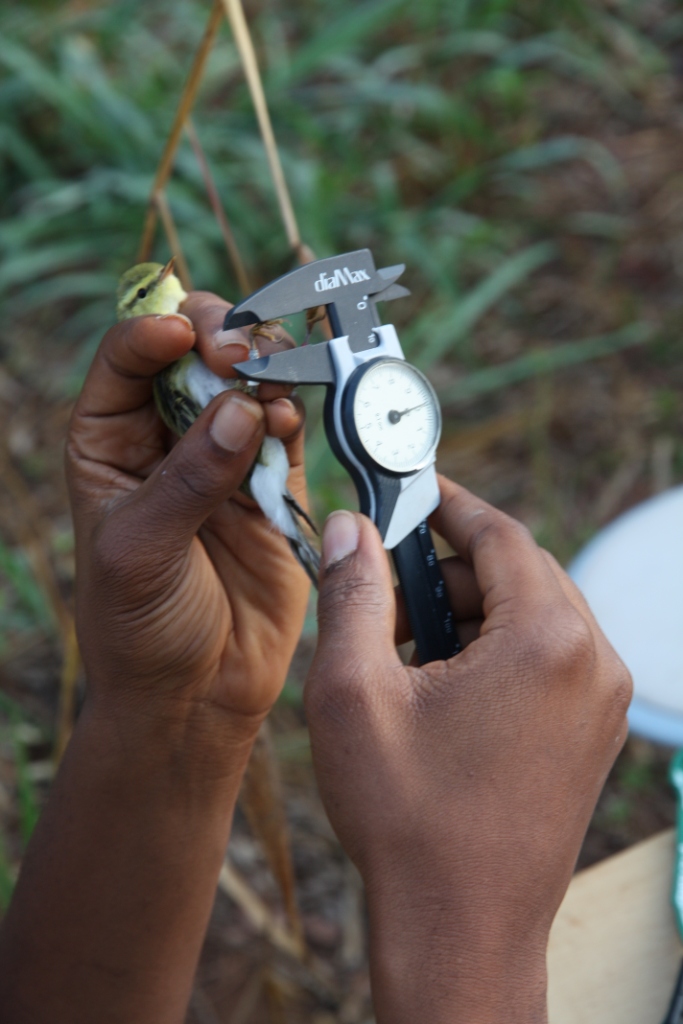
Above photo: measuring the tarsus

Above photo: checking age and for any moult


Above photo: our first radio-tagged wood warbler


Thankfully even with two birds to process the job is done smoothly and efficiently, and before long we’re re-checking that the tags are working. The birds are released with their new mini-transmitters, and they promptly disappear. Moments later we check the frequencies again, and still receiving them there’s a great sense of relief and satisfaction all round. Job well done! Just hope we can find them again later....


With Japheth off for an overdue weekend off, we take him to Nkawkaw to catch his bus. It will be down to me and Emmanuel to hunt those birds down tomorrow. Not knowing how much time this will take, we decide to put off attempting to catch more until we get a good sense of the work involved tracking just the two birds.
Above photo: Nkawkaw traffic


Back west Bee, Chas and Oppong take time out from a hectic fieldwork schedule to explore the local market and search for some bargains!
Above photo: vegetable stall at Nsoatre market

Above photo: villagers sorting through clothes at Nsoatre market